Crane Services Along the I-90 Corridor: Moses Lake to Spokane
·8 min read
Interstate 90 cuts straight across Washington State, connecting Moses Lake to Spokane and passing through some of the most economically diverse territory in Eastern Washington. If you're working on a project anywhere along this corridor—whether it's in Moses Lake, Ritzville, Sprague, or the Spokane metro area—you need crane services that understand the region.
At Central Washington Crane & Riging, we're based in Moses Lake and work the entire I-90 corridor regularly. Here's what you should know about crane services along this route and why regional experience matters.
Why the I-90 Corridor Matters
I-90 isn't just a highway—it's an economic artery. You've got:
- Agricultural operations throughout Grant and Adams Counties
- Data centers and tech infrastructure in Moses Lake and Quincy
- Manufacturing and distribution facilities taking advantage of central locations
- Wind energy projects across the Columbia Plateau
- Spokane's industrial and commercial growth on the eastern end
- Small town infrastructure projects in Ritzville, Sprague, and other communities along the route
This corridor sees constant construction, equipment installation, facility upgrades, and infrastructure work. That means crane work isn't seasonal or occasional—it's ongoing.
What Makes I-90 Corridor Crane Work Different
Working along I-90 means dealing with diverse conditions and project types within a relatively compact geographic area. Here's what that looks like:
Geographic and Weather Variability
Moses Lake sits at about 1,000 feet elevation. By the time you reach Spokane, you're around 1,900 feet, and you've crossed from the dry Columbia Basin into a climate with more precipitation and different wind patterns.
We know how wind behaves differently in Moses Lake versus Ritzville versus Spokane Valley. We know which times of year bring the strongest gusts and how to plan around them. We know when ground conditions are firm and when you need additional ground protection for outriggers.
That might sound like minor details, but when you're setting up a crane of any size, local knowledge prevents delays and safety issues.
Project Type Diversity
In Moses Lake, we might be installing servers in a data center. An hour east in Ritzville, we're setting equipment for an agricultural operation. In Spokane, we're placing HVAC units on a commercial building or handling manufacturing equipment in the Valley.
Different projects require different rigging approaches, different planning considerations, and different communication with different types of clients. A data center project manager has different priorities than a farmer upgrading grain handling equipment. We're fluent in both conversations.
Mobilization Efficiency
Being based in Moses Lake means we're centrally positioned along the I-90 corridor. We can reach most of the corridor efficiently without the long mobilization times you'd get from a Spokane-only or Seattle-based provider.
For planned projects, mobilization time is less critical—you schedule around it. But for emergency work or time-sensitive installations, having a crane provider positioned along the corridor rather than on one end of it matters.
Common I-90 Corridor Crane Applications
Here's the kind of work we handle regularly along the I-90 route:
Moses Lake and Grant County:
- Data center equipment installation (servers, cooling systems, generators)
- Agricultural equipment (grain systems, food processing)
- Commercial construction (retail, office, warehouse)
- Wind energy components
Ritzville and Adams County:
- Agricultural operations (grain elevators, processing facilities)
- Municipal infrastructure (water systems, power substations)
- Commercial building construction
- Equipment relocation for expanding farms
Spokane and Spokane Valley:
- Industrial manufacturing equipment
- Commercial HVAC and mechanical systems
- Healthcare facility equipment (MRI, generators, chillers)
- Distribution center construction
- Office building construction
Small Communities Along I-90:
- Municipal infrastructure projects
- Grain cooperative equipment
- School and public facility construction
- Emergency equipment replacement
Equipment That Works Across the Corridor
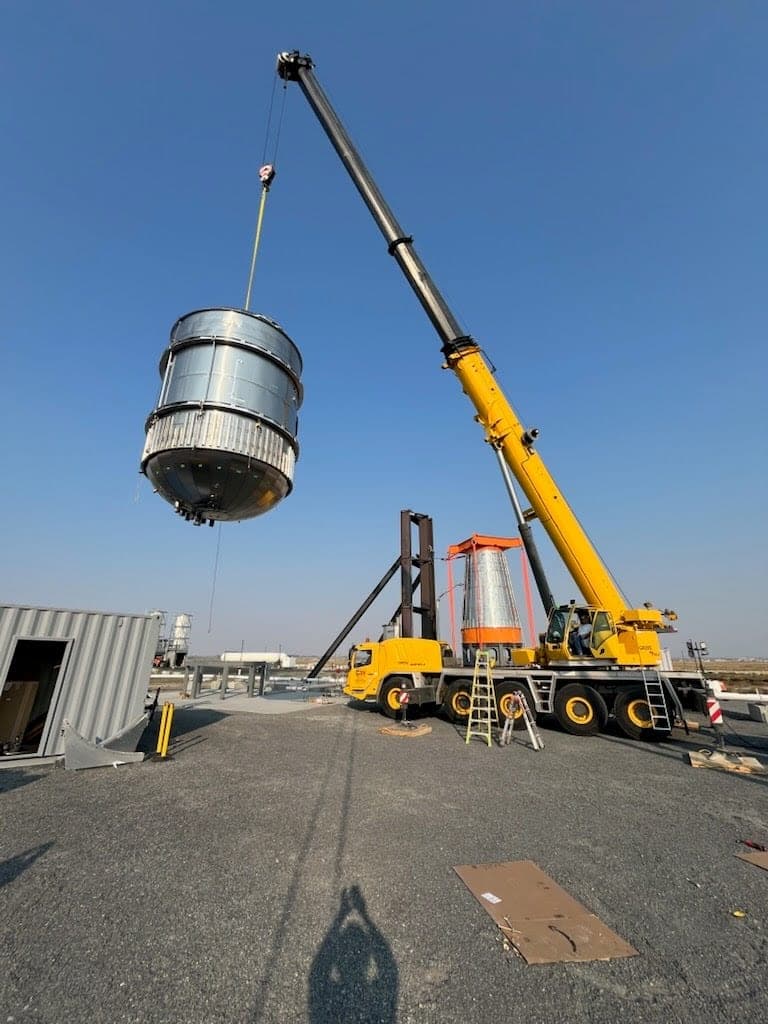
Our 165-ton Grove GMK5165-2 with a 197-foot main boom handles the majority of commercial and industrial work along I-90, and we scale up to 230-ton crawler capacity when a job calls for it. All-terrain cranes can travel on highways and handle varied ground conditions, which is essential when you're working everywhere from prepared industrial sites to agricultural properties with less formal infrastructure.
If your project needs something bigger—say, a major industrial installation in Spokane that requires 300+ ton capacity—we'll tell you that upfront. We'd rather be honest about our equipment limits than promise something we can't deliver.
NCCCO Certification Across State Lines
Every one of our crane operators is NCCCO certified—that's the National Commission for the Certification of Crane Operators, the highest industry standard.
Washington State requires crane operator certification, but not all companies use NCCCO. Some use alternative certifications that technically meet legal requirements but aren't as rigorous. When you hire us for a project anywhere along I-90, you're getting operators who've passed the toughest testing in the industry.
Ask any crane company you're considering: "Are your operators NCCCO certified?" If they hesitate or mention a different certification, that tells you something about their standards.
Rigging Expertise, Not Just Crane Operation
A crane gets the attention, but rigging is what makes the lift work. We're not just crane operators—we're riggers. That means we understand:
- Load calculations and center of gravity
- Sling angles and tension distribution
- Attachment point selection
- Spreader beam and lifting beam applications
- Environmental factors that affect the lift
We can provide PE-stamped engineered lift plans when your project requires them. That's critical for complex lifts, lifts over occupied spaces, or projects with specific engineering requirements in the contract. Not every crane company offers this, and waiting to find an engineer after you've hired a crane provider delays your project.
Tri-State Licensing and Experience
We hold crane operator licenses in Washington, Oregon, and Idaho. While I-90 stays in Washington until it crosses into Idaho near Spokane, many of our I-90 corridor clients operate facilities in multiple states.
If you're a company with operations in Moses Lake and another facility in Coeur d'Alene, or if you're a contractor working projects in both Washington and Idaho, you can use the same crane provider for both. We understand the regulatory requirements in all three states.
Questions to Ask Any I-90 Corridor Crane Provider
Before you hire a crane company for work along the I-90 corridor—whether it's us or someone else—here are the questions you should ask:
- Are all your operators NCCCO certified? (Not just "certified," specifically NCCCO.)
- What's the capacity and reach of your equipment? (Make sure it fits your actual needs.)
- Do you provide rigging services, or just the crane? (Some companies rent bare equipment only.)
- Can you provide engineered lift plans if needed? (Critical for complex or regulated projects.)
- What's included in your quote? (Mobilization? Rigging equipment? Operator time? Clarify everything.)
- What's your safety record? (Any reputable company should be willing to discuss this.)
- How much experience do you have in this specific region? (Local knowledge prevents problems.)
If a company can't answer these clearly, or if they're evasive about certification or safety records, that's a red flag.
Beyond Just Crane Services
A lot of projects along I-90 need more than just a crane. Maybe you're relocating a production line and need machinery moving services. Maybe you need equipment storage between facilities. Maybe you need a complete rigging solution with engineered lift plans.
We handle all of that. Crane rental, rigging, machinery moving, equipment storage, and PE-stamped lift plans. If your project involves moving heavy equipment safely anywhere along the I-90 corridor, we can probably help—or we'll tell you honestly if it's outside our scope.
What to Expect When You Work With Us
Here's how a typical I-90 corridor project works:
- Initial Contact: Call or email us with your project details. What needs to be lifted? Where is it now, and where does it need to go? What's the weight (or best estimate)? What's your timeline?
- Site Assessment: For complex lifts, we visit the site. We need to see access routes, ground conditions, overhead obstructions, and placement location. This ensures we're quoting accurately and planning appropriately.
- Lift Plan and Quote: We provide a detailed quote that includes crane rental, operator time, mobilization, rigging equipment, and any engineered lift plans if required. No surprise charges.
- Scheduling: We lock in dates that work for your project timeline. We communicate clearly about arrival times and estimated duration.
- Execution: Our NCCCO-certified operators show up with the crane and all necessary rigging. We handle the lift according to the plan, with safety as the top priority.
- Follow-Up: If there's anything that needs adjustment or if you have questions after the fact, we're available.
Regional Experience Along the Entire Corridor
We've been working the I-90 corridor for over 20 years. We know the contractors, the building inspectors, the permitting processes, and the local conditions from Moses Lake to Spokane.
That familiarity speeds things up. We know which jurisdictions require what permits. We know which building departments are easy to work with and which ones need extra documentation. We know where to stage equipment, where ground conditions require special attention, and how local wind patterns affect lift planning.
That's not something you get from a company that only occasionally works the corridor. It's the result of doing this work, in this region, for two decades.
Serving the I-90 Corridor and Beyond
While I-90 is a major focus, we work throughout Eastern Washington, Northeastern Oregon, and North Idaho. If your company has facilities in multiple locations—a plant in Moses Lake and another in the Tri-Cities, or a project in Spokane and another in Coeur d'Alene—you can use the same crane provider for all of them.
That consistency matters. You're working with operators who understand your standards, project managers who know your communication preferences, and equipment you've already verified meets your requirements.
Ready to Talk About Your I-90 Corridor Project?
Whether you're installing data center equipment in Moses Lake, upgrading agricultural facilities in Ritzville, or handling commercial construction in Spokane Valley, we'd be glad to discuss your project.
Call us at 509-797-4092, email tom@cwcrane-rigging.com, or use the contact form on our website at cwcrane-rigging.com. We'll answer your questions, provide a clear quote, and show up ready to work when you need us.